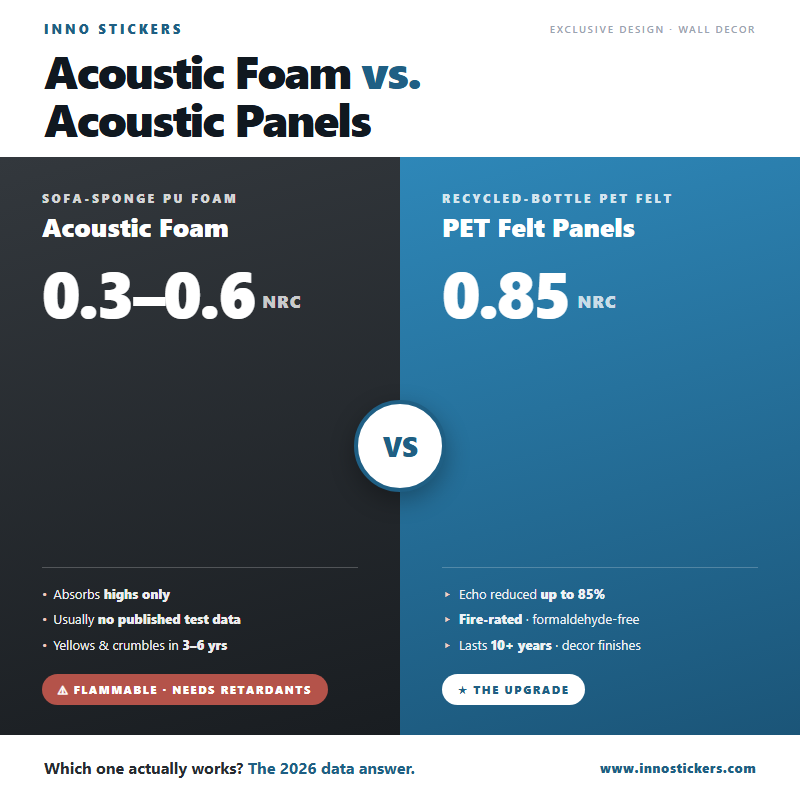
Short answer: Yes — acoustic wall panels reduce echo, reverberation, and that hollow "room boom" by absorbing sound. Quality panels carry an NRC (Noise Reduction Coefficient) of around 0.85, meaning they absorb roughly 85% of the sound energy that hits them. No — they do not block noise from traveling through walls or from your neighbors; that is a different problem called soundproofing, and it requires mass and sealing, not panels.
This guide explains exactly what acoustic panels can and cannot fix — with the numbers behind the claims — so you buy the right solution the first time and don't waste money on the wrong one.
What Acoustic Panels Do — and What They Don't
The single biggest mistake in this category is treating "acoustic treatment" and "soundproofing" as the same thing. They are two completely different problems, measured with two different ratings:
| Acoustic panels (sound absorption) | Soundproofing (sound blocking) | |
|---|---|---|
| What it fixes | Echo and reverb inside a room | Sound passing between rooms |
| Rating | NRC — Noise Reduction Coefficient (0.0–1.0) | STC — Sound Transmission Class |
| How it works | Fibrous material converts sound energy into tiny amounts of heat | Mass + decoupling + sealing stops vibration passing through the structure |
| Cost scale | Product purchase, install in hours | Construction, typically $15–50 per sq ft |
| Example products | PET felt panels, fabric-wrapped panels, felt-backed wood slat panels | Double drywall, mass-loaded vinyl, resilient channels, door seals |
Two numbers tell the story: bare drywall absorbs almost nothing — it rates about NRC 0.05. A wall rated STC 25 lets normal speech through clearly; STC 40 turns loud speech into a murmur; and US building codes generally require STC 50 between dwelling units. A panel with NRC 0.85 does nothing to a wall's STC, and a wall with STC 50 does nothing to stop echo inside a room. Match the product to the problem.
How Sound Absorption Actually Works
When a sound wave hits a hard surface, almost all of it bounces back — that bounce is the echo you hear. When it hits a porous material like PET acoustic felt, the wave enters the material and travels through thousands of tiny fibers. Friction between the fibers and air molecules converts the sound energy into heat. The sound doesn't come back; it becomes a fraction of a degree of warmth.
This is also why absorbing panels cannot block sound: the same porous structure that lets sound waves in to be absorbed also lets sound waves pass through. Blocking requires the exact opposite — dense mass that sound cannot vibrate. Absorption and blocking are physically opposed, which is why one product cannot do both jobs.
One honest limit: a standard panel absorbs mid and high frequencies best. A roughly 0.4-inch (10 mm) felt starts working around 250 Hz and up; deep bass below 125 Hz has wavelengths so long that only thick corner traps or large air gaps meaningfully tame it. If your complaint is a neighbor's subwoofer thumping through the wall, that is transmission, not echo — see "What Acoustic Panels Cannot Do" below.
What NRC Really Means (with Real Material Numbers)
NRC is a single number from 0.0 to 1.0: 0.0 means a surface reflects all sound, 1.0 means it absorbs all sound. An NRC of 0.85 means the panel absorbs 85% of the sound energy that hits it, and only 15% bounces back.
To put that in context, here is how common surfaces and materials rate:
| Surface / material | Typical NRC | Notes |
|---|---|---|
| Bare drywall | ~0.05 | Reflects almost everything |
| Carpet | ~0.30 | Absorbs some mid-frequency sound |
| Budget foam tiles (1") | 0.30–0.50 | Absorb highs only; most sound bounces |
| PET acoustic felt panels | 0.80–0.95 | The working class for real echo control |
| Fabric-wrapped mineral wool (2") | 0.85–1.0 | Studio-grade |
Practical rule for shoppers: if a product won't state its NRC, assume it barely absorbs. Reputable manufacturers publish their numbers. A textured foam tile that looks acoustic can still score a mediocre 0.3–0.5, while flat PET felt panels routinely beat it.
When Acoustic Panels Make a Real Difference
Do a 10-second self-check. You are a good candidate for acoustic panels if your room:
- Sounds hollow or "boomy" when you clap or talk
- Makes video calls echo — you hear yourself bounce back
- Forces you to repeat yourself across a kitchen island or conference table
- Is a home theater or studio where voices and music blur together
These symptoms are all reverberation: sound bouncing off hard surfaces and piling up. Acoustic panels fix it, and the improvement is measurable, not a vibe:
- Covering 20–30% of a room's wall area with NRC 0.85-class panels typically cuts perceived echo by 40–60%
- Even 15–25% coverage gives a clearly noticeable change
- Placement beats quantity: treating the first reflection points (where sound from your speakers bounces straight at your ears) delivers roughly 80% of the benefit with 20% of the panels
- For a typical 10 × 12 ft home room, 6–12 panels placed strategically is the realistic benchmark — beyond about 50% coverage you get diminishing returns, and a room can start to feel dead
Panels are at their best in home theaters, home offices, podcast and video-call setups, open kitchens with hard floors, hallways, and studios — anywhere sound quality matters but a full construction project doesn't make sense.
What Acoustic Panels Cannot Do
Be clear about the boundary, because it saves real money:
Acoustic panels cannot stop sound from entering or leaving a room. If you can hear your neighbors, traffic, or the TV from the next room, panels will not change that. Sound travels through walls as structural vibration; a thin, porous panel mounted on the surface does nothing to interrupt it. People who cover an entire wall in panels hoping to silence a shared wall are disappointed every time.
To block sound you need the three things construction does:
- Mass — heavy assemblies (a second layer of drywall, mass-loaded vinyl) that resist vibration
- Decoupling — resilient channels or clips that break the vibration path
- Air sealing — closing every gap, because one unsealed crack defeats the whole wall
If you need both isolation and good sound inside the room, do the structural work first, then add absorption panels on top. The order matters — panels cannot compensate for an unsealed wall, but a sealed wall will still echo until you add absorption.
PET Felt vs. Solid Wood vs. PVC: Which Wall Panel Material Actually Absorbs Sound?
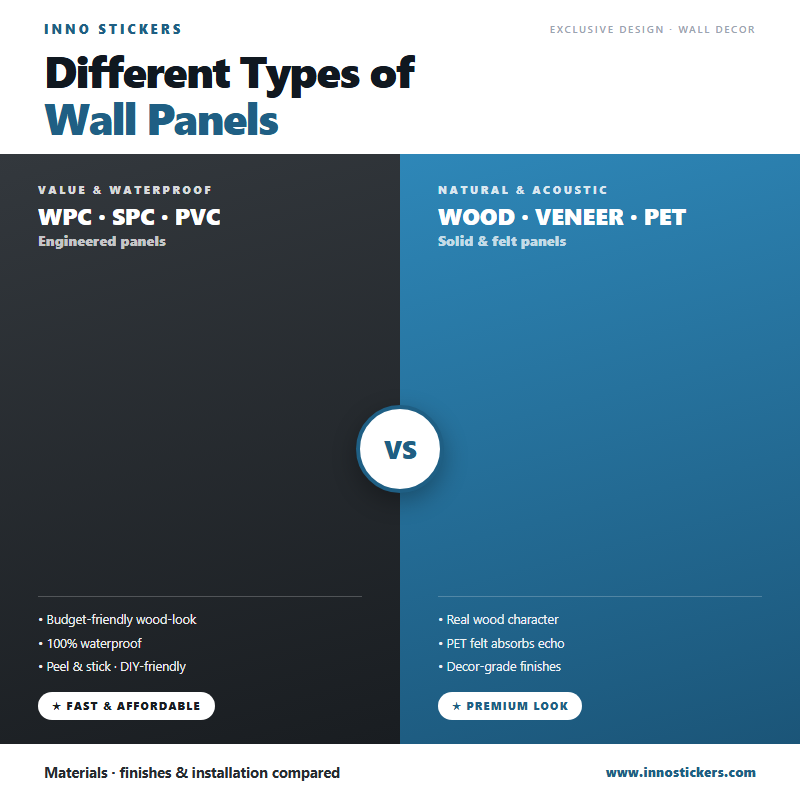
If you are choosing wall panels and want acoustic benefit, the material decides everything. Three popular families — but only one absorbs:
| Panel material | How it handles sound | Typical NRC | Bottom line |
|---|---|---|---|
| PET acoustic felt (acoustic tiles, felt-backed slat panels) | Porous recycled-fiber felt absorbs sound | 0.80–0.95 class | The only one that genuinely quiets a room |
| Solid wood panels (no felt backing) | Dense, non-porous surface — mostly reflects | ~0.05–0.10 | Beautiful, but essentially no sound absorption |
| PVC / vinyl panels | Hard impervious surface — reflects | ~0.05–0.15 | Waterproof and budget-friendly; no absorption |
The physics is the same as before: solid wood and PVC are dense and non-porous, so they sit at roughly the same near-zero absorption as bare drywall. They are excellent decorative and waterproofing choices — they just should not be sold (or bought) on acoustic promises. If "less echo" is a goal, the felt is doing the work, so look for a genuine PET or felt-backed product with a published NRC.
Wood-Slat Acoustic Panels: Absorption That Looks Like Furniture
This is the category where acoustic performance and interior design finally meet. Wood-slat acoustic panels combine timber veneer slats with a recycled PET felt backing: the felt between and behind the slats absorbs sound, while the wood keeps the wall looking warm and architectural — no grey studio foam anywhere.

Inno Stickers' Walnut Wood Slat Acoustic Panels ($99.99) are a good example of the spec you should look for: hand-cut, hand-oiled wood veneer slats (1" wide with 0.15" gaps) pre-bonded to a recycled PET felt backing that carries the absorption. Sound waves get trapped between the slats and inside the felt — the panels' tested claim is echo reduction of up to 85% in the room they treat. Each panel measures 47.2" × 23.6" × 0.4", a box of four covers 31 sq ft, and it comes in both Peel & Stick and Glue-Down versions — install in an afternoon with no special tools. The panels are formaldehyde-free (P2 per ASTM D6007-22, E0 per EN 717-1) and suit dry areas only: TV walls, bedroom feature walls, ceilings, offices, and studios.

The same PET felt technology is also available in smaller-format acoustic tiles for targeted coverage — a great way to treat just the TV wall or the wall behind a desk. The Diagonal Slat Natural Oak PET Acoustic Tile ($59.99) adds the slat look in a compact tile, and the Grey Faux Brick PET Acoustic Tile ($69.99) brings industrial brick texture with sound absorption — a decorative pattern you would never expect to double as an acoustic panel.


One honest note on slat panels: absorption scales with how much felt is exposed. Full-coverage felt tiles absorb the most; a slat panel trades a little absorption for a lot of aesthetics. For a living room or office where "quieter and calmer" is the goal and appearance matters, that trade is usually the right one.
FAQ
Do acoustic panels block noise from the next room?▼
No. Acoustic panels absorb echo and reverb inside the room they are installed in — they do not stop sound traveling through walls, floors, or ceilings. Blocking sound from a neighbor requires mass, decoupling, and air sealing (soundproofing construction), not surface panels. If your problem is echo, panels fix it; if your problem is sound coming through a wall, panels won't.
What does an NRC rating of 0.85 mean?▼
NRC (Noise Reduction Coefficient) measures how much sound a surface absorbs, on a scale from 0.0 to 1.0. An NRC of 0.85 means the panel absorbs 85% of the sound energy that hits it and reflects only 15%. For comparison, bare drywall absorbs about 5% (NRC ~0.05). Higher NRC = less echo in the room.
How many acoustic panels do I need to notice a difference?▼
As a rule of thumb, covering 20–30% of a room's wall area with NRC 0.85-class panels cuts perceived echo by 40–60%, and 15–25% coverage is already noticeable. For a typical 10 × 12 ft room, 6–12 strategically placed panels is the realistic benchmark. Start with first reflection points (the spots where sound bounces straight from your speakers toward your ears) — placement matters more than quantity.
Do wood slat acoustic panels work as well as foam panels?▼
On absorption, yes — quality PET-felt-backed slat panels perform in the same NRC 0.85 class as premium panels, while budget foam tiles typically score only 0.30–0.50 and absorb just high frequencies. On looks, there is no contest: wood slat panels read as interior design, foam reads as a recording booth. Slat panels trade a little absorption (felt is partially covered by wood) for a much more livable aesthetic — the right trade for living rooms and offices.
Which absorbs sound better: PET acoustic, solid wood, or PVC panels?▼
PET acoustic panels, by a wide margin. PET felt is porous, so it absorbs sound (NRC 0.80–0.95 class). Solid wood and PVC are dense, non-porous surfaces that mostly reflect sound — roughly NRC 0.05–0.10, essentially the same as bare drywall — so they are great for looks and waterproofing but offer no meaningful acoustic benefit. If "less echo" is part of your goal, choose a genuine PET or felt-backed panel with a published NRC.
Are acoustic wall panels worth the money?▼
If your problem is echo, reverb, or poor speech clarity inside a room — yes. A room's acoustic treatment costs a few hundred dollars in panels and installs in an afternoon, while soundproofing construction runs $15–50 per sq ft and takes contractors days to weeks. If your problem is noise coming through walls, panels are not worth it for that job — spend the money on sealing and mass instead.
The Bottom Line
- Echo inside a room → acoustic panels fix it. Look for NRC 0.85-class PET felt or felt-backed panels; cover 20–30% of the wall area, starting at first reflection points.
- Noise between rooms → panels will not fix it. That needs mass, decoupling, and sealing — soundproofing construction, not surface treatment.
- If you want quieter and beautiful, wood-slat acoustic panels with a PET felt backing give you absorption that looks like furniture — no foam required.
Ready to Quiet Down a Wall?
Inno Stickers ships free to 48 US states, backs every panel with a 3-year warranty and 30-day returns, and our customer care team answers within 24 hours.
This week: use code INNOSTICKERS at checkout for 12% OFF your entire order.
Shop the BestsellerStart with the Walnut Wood Slat Acoustic Panels, browse all Wall Paneling (verify handle in admin), or get more answers on our Wall Panel FAQ page.